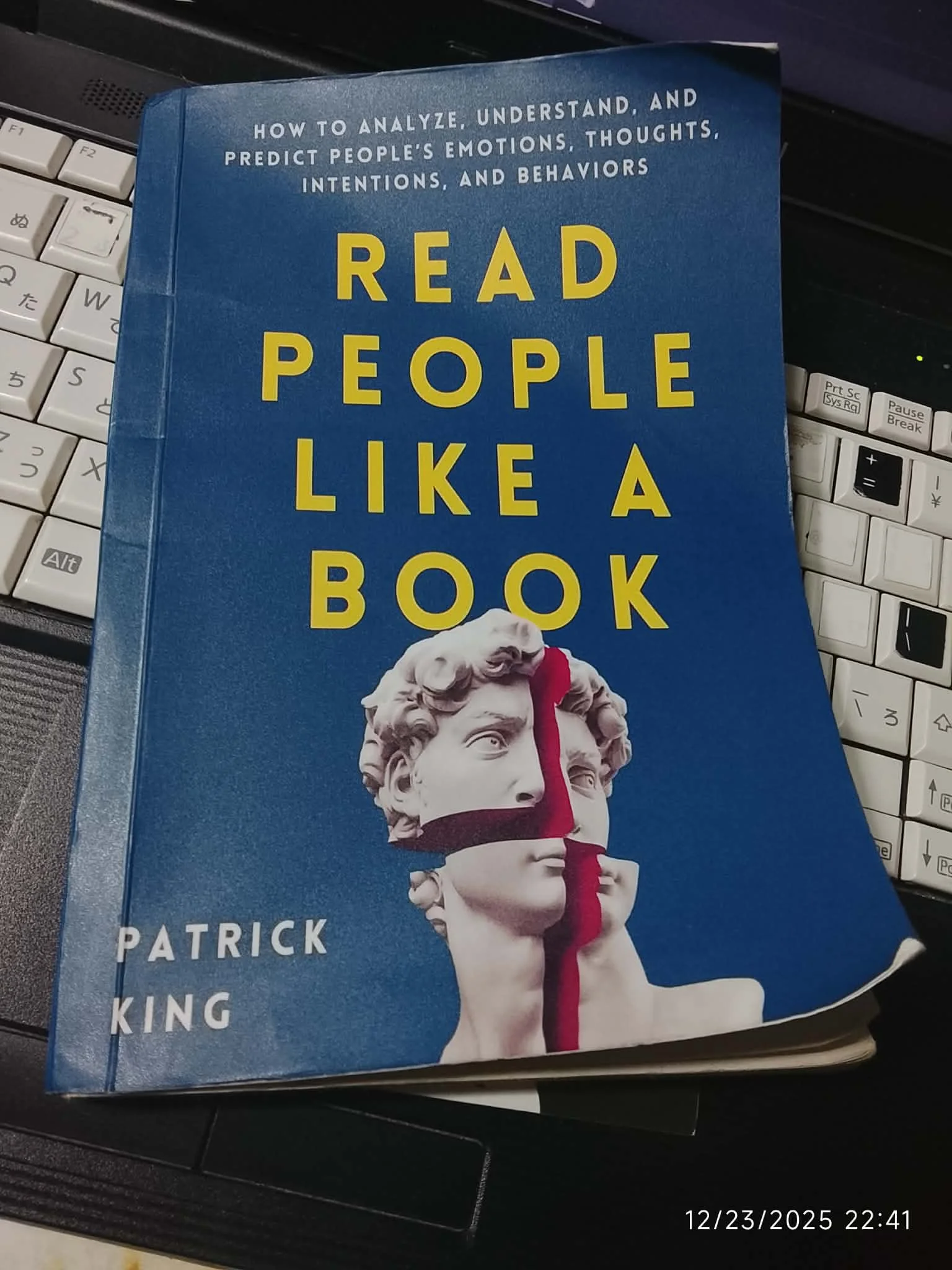
Book Report: How to Read People Like a Book
Introduction
How to Read People Like a Book emphasizes that most human communication is non-verbal, and spoken words often fail to reflect true thoughts and emotions. As a result, the ability to read people effectively becomes a valuable life skill. The book highlights that accurate interpretation of behavior requires attention to context, cultural background, and personal baselines. Single gestures or expressions rarely provide reliable insight; instead, clusters of behavior must be analyzed together.
Self-awareness is equally important, as personal biases, expectations, and unconscious drives can distort perception. By recognizing one’s own mental filters and observing without immediate judgment, individuals can develop the ability to interpret others more objectively. The book also recommends assessing current proficiency in people-reading, using tests like Simon Baron-Cohen’s social intelligence assessment to gauge how accurately one perceives emotions.
Chapter 1: Motivation as a Behavioral Predictor
Chapter one focuses on understanding motivation as a foundation for predicting behavior. The book begins with the pleasure principle, which explains that people are naturally driven to seek pleasure and avoid pain. Recognizing what pleasures or pains influence an individual can clarify why they act in certain ways.
Next, the book introduces Maslow’s Hierarchy of Needs, a framework that categorizes motivations into five levels: physiological needs, safety, love and belonging, esteem, and self-actualization. Observing which level a person is focused on helps explain their current behavior and goals.
The chapter also addresses ego defense mechanisms, unconscious strategies that protect self-esteem. Examples include denial, rationalization, projection, repression, and displacement. Because these defenses can shape behavior unconsciously, understanding when the ego is involved helps readers interpret actions more accurately.
Chapter 2: The Body, the Face, and Behavior Clusters
Chapter two shifts to direct observation, examining facial expressions and body language as key sources of insight. Facial expressions are categorized into macroexpressions—slower, more obvious, and often consciously controlled—and microexpressions, which are rapid, involuntary, and reveal true emotions. Psychologist Paul Ekman’s research highlights microexpressions for the six basic emotions, as well as signs of nervousness, lying, or discomfort.
Body language provides further context. Relaxed individuals often expand into space, while anxious or insecure individuals contract or exhibit self-soothing gestures. However, interpretation is meaningful only when compared against a baseline of normal behavior for that person.
The book emphasizes analyzing behavioral clusters, where multiple cues—facial expressions, gestures, posture, and voice—combine to communicate a unified message. Incongruences among these cues may indicate hidden emotions, but conclusions should be drawn carefully, supported by sufficient observations rather than isolated signs.
Chapter 3: Personality Science and Typology
Chapter three introduces personality frameworks as tools for understanding individual differences. The Big Five Personality Traits—openness, conscientiousness, extroversion, agreeableness, and neuroticism (OCEAN)—measure personality along continuums rather than fixed categories. Observing these traits helps predict behavior, preferences, and social tendencies.
The Myers-Briggs Type Indicator (MBTI) is another framework, classifying people into sixteen personality types based on four dimensions: introversion/extroversion, sensing/intuition, thinking/feeling, and judging/perceiving. While the MBTI can provide useful insights, it has limitations such as inconsistency in results and reliance on stereotypes.
The book also covers the Keirsey Temperament Theory, which groups personality into four broader temperaments—guardian, artisan, idealist, and rational—emphasizing general behavior patterns over detailed subtypes. The Enneagram, with its nine personality types, focuses on motivations, fears, and emotional patterns, offering another lens to understand behavior and interpersonal dynamics. These frameworks allow readers to approach people scientifically while recognizing individual variation.
Chapter 4: Lie Detection 101
Chapter four explores detecting deception, highlighting that most people overestimate their ability to spot lies. Biases and assumptions often obscure recognition of deceit. Effective lie detection relies on strategic conversation, rather than solely observing body language.
Techniques include asking open-ended questions, looking for inconsistencies, and presenting unexpected questions to increase cognitive load, which can make liars slip. Physiological and behavioral signs of lying may include delayed responses, speech errors, reduced emotional expression, blinking, and pupil dilation. The chapter emphasizes that no single cue proves deception; rather, patterns and context are key.
Chapter 5: Using the Power of Observation
The final chapter teaches how to efficiently gather insights through observation. Thin slicing, or making accurate judgments from limited data, can be surprisingly effective. Readers are encouraged to trust initial impressions while supporting them with careful follow-up observations.
Language in texts and emails reveals personality traits, emotional states, and values. Overly negative or emotionally disproportionate messages may indicate low self-esteem or mental strain. Observation extends to physical spaces and possessions: homes, offices, and personal items reflect habits, sociability, and self-perception. Online behavior can also offer insights, though interpretation requires caution.
Hypothetical questions are suggested as a tool to bypass defenses, eliciting honest information about desires, values, and self-perception. Overall, careful observation, combined with context and baseline knowledge, allows readers to understand others effectively and ethically.
Conclusion
How to Read People Like a Book provides a practical framework for understanding human behavior through motivation, observation, personality analysis, and communication. By integrating theory with careful observation and self-awareness, readers can improve social intelligence, strengthen interpersonal relationships, and make more informed judgments about others. The book emphasizes ethical, context-sensitive people-reading, showing that accurate understanding requires both skill and patience.