
Bayanihan: Bulacan Pre-Development Research and Scaffolding Document
Bayanihan: Bulacan Pre-Development Research and Scaffolding Document
Research Significance and Private Collaboration Framework in the Bulacan Region
Research Significance and Causal Socioeconomic Dynamics
This pre-development document provides the technical, structural, and legal scaffolding for Bayanihan, an autonomous, decentralized collective intelligence platform designed specifically for the Philippines1. Operating with a strict mandate of zero government involvement, the platform retains 100% private ownership and control to protect its architecture from political pressure, administrative bottlenecks, or bureaucratic capture1. The operational deployment of the platform is focused on the Bulacan region, specifically targeting the urban-rural corridor of Malolos and Plaridel1. This region serves as a critical agricultural and enterprise hub, yet it remains vulnerable to recurring environmental and structural disruptions2.
The primary research question driving this architecture is: How can an autonomous, decentralized collective intelligence network solve localized agricultural, economic, and infrastructure problems in the Philippines without relying on state funding, municipal deployment permissions, or public platform infrastructure1?
The Bulacan region exhibits specific environmental vulnerabilities that require coordinated, peer-reviewed solutions4. For instance, structural flooding in Barangay Barihan, Malolos, has historically left farm-to-market roads submerged for up to a year, isolating agrarian reform communities and halting economic activity4. Similarly, localized issues in Plaridel, such as mechanical inefficiencies at the Parulan Halang Irrigators Association, highlight the need for targeted interventions in grain-drying and water-resource management4.
By operating independently of municipal Local Government Units (LGUs)—including the municipal agricultural offices of Plaridel and Malolos5 and the Provincial Cooperative and Enterprise Development Office (PCEDO)2—Bayanihan avoids bureaucratic delays and political capture1. State networks, specifically Bulacan State University (BulSU), are utilized strictly as a passive, non-authoritative research baseline1. The platform references academic studies from BulSU’s Center for Bulacan Studies (Bahay-Saliksikan ng Bulacan)7, student resource-coping models8, and campus-based ecological laboratory metrics9 to establish research baselines1. This approach allows the platform to use existing data without granting state actors authority over the platform’s codebase, data pipelines, or operational policies1.
To illustrate how these local dynamics are mapped, the table below highlights the alignment of localized socioeconomic issues with non-state assets and BulSU research baselines:
| Disrupted Agricultural Zone | Specific Community Asset / Cooperative | Baseline Research Baseline (BulSU) | Local Solution Vector |
|---|---|---|---|
| Barangay Barihan, Malolos | Caniogan Credit and Development Cooperative10 | Socio-Cultural Resource Conservation and Coping Models8 | Flood-resilient logistics routing and community-led mutual aid distribution10. |
| Banga I, Plaridel | Samahang Manggagawa Credit Cooperative10 | Business History and Start-up Resiliency Clusters12 | Decentralized micro-credit ledgers and interest-free emergency capital pipelines10. |
| Parulan, Plaridel | Parulan Halang Irrigators Association4 | Pure and Applied Sciences Environmental Data12 | Low-cost recirculating dryer modifications and solar pump optimization4. |
Academic Integration Strategy
The platform establishes direct pipeline agreements with student organizations, academic departments, and research groups within leading private higher education institutions (HEIs) in Malolos and Plaridel1. This strategy bypasses public university systems entirely, avoiding external administrative oversight1.
The academic integration strategy targets three main private institutions:
- La Consolacion University Philippines (LCUP - Malolos Campus): Sited at Valenzuela St., Capitol View Park Subdivision, Bulihan, Malolos13. Administered by the Augustinian Sisters of Our Lady of Consolation14, LCUP possesses strong departments in the College of Information Technology and Engineering (CITE) and the College of Business, Entrepreneurship, and Accountancy (CBEA)13. Sourcing targets student groups to analyze local supply-chain logistics and design systems using LCUP’s digital payment frameworks as reference models13.
- Centro Escolar University Malolos (CEU Malolos): Sited at Km 44 McArthur Highway, Malolos16. Student integration is coordinated through Dean of Studies Dr. Ma. Flordeliza L. Anastacio16, with technical pipelines managed by Ms. Josan D. Tamayo (IT Program Head), Dr. Maria Dinna P. Aviñante (Business Administration), and Ms. Cecilia C. Catahan (Accountancy)16. Students utilize campus facilities, such as the Ada Hotel mini-hotel and the 5,000-seat Centrodome, as practical training environments to model service operations and localized business audits17.
- Richwell Colleges Incorporated (Plaridel Campus): Sited along Gen. Alejo Santos Road, San Jose, Plaridel18. Coordinated with Administrator Mr. Romeo Dela Rosa19, integration leverages students in Agricultural Crops Production (led by Joshua Marie P. Espiritu) and Visual Graphic Design (led by Jayson Jerald V. Rivera)18 to address post-harvest agricultural losses and localized logistics.
The table below outlines the operational integration of these private HEIs:
| Private HEI | Department / Lead Coordinator | Target Student Sourcing | Platform Integration Mechanism |
|---|---|---|---|
| La Consolacion University Philippines (LCUP) | CBEA & CITE13 / Sr. Niceta M. Vargas, Ph.D.14 | Advanced Business & Systems Engineering Undergraduates13 | Interactive modeling of local microfinance risk and digital logistics ledgers13. |
| Centro Escolar University Malolos | IT, Accountancy & Business16 / Dr. Ma. Flordeliza L. Anastacio16 | Applied Information Technology and Audit Majors16 | Technical coding of API hooks and operational audits for local MSMEs16. |
| Richwell Colleges Incorporated | Technical-Vocational & BS Programs21 / Mr. Romeo Dela Rosa19 | Agricultural Crops Production & Visual Graphic Design Students18 | Direct submission of post-harvest crop management solutions and graphic schematics18. |
These departments are provided with an independent “Premium Portfolio Builder” API integration1. This allows department chairs and deans to credit student contributions directly toward thesis metrics, research projects, or graduation practicum requirements1. This process bypasses state agencies such as the Commission on Higher Education (CHED) or the Technical Education and Skills Development Authority (TESDA), keeping the validation loop entirely within the private academic network1.
Independent Cooperative and Foundation Integration
Rather than utilizing state-directed agricultural networks or public programs, Bayanihan sources community cases directly from established private cooperatives and mutual-aid associations1. These organizations represent verified non-state actors with deep roots in Bulacan’s agricultural and enterprise sectors2.
The platform interfaces directly with:
- Parulan Halang Irrigators Association (Plaridel): Surfacing technical challenges related to grain drying, fuel costs, and shallow tube well irrigation networks4.
- Samahang Manggagawa Credit Cooperative (Plaridel): surrendering operational data on microfinance loans, community consumer goods distribution, and localized transport needs10.
- Caniogan Credit and Development Cooperative (Malolos): Onboarding multi-million peso community relief case files to identify credit gaps and supply chain vulnerabilities10.
These private cooperatives are onboarded with independent poster accounts1. This allows them to post real-world problems directly to the platform, bypassing municipal LGUs and provincial agrarian reform offices1. This direct integration model ensures that case studies are sourced from active, on-the-ground operators, avoiding the risk of state administrative capture or political filtering of local concerns1.
Corporate CSR Capital Sourcing
Bayanihan operates without government grants or public research funding, such as DOST or DICT subsidies1. Financial sustainability is achieved by routing private corporate philanthropic capital through the tax incentive frameworks established by the National Internal Revenue Code (NIRC), amended by the TRAIN Law (Republic Act No. 10963) and the CREATE Law (Republic Act No. 11534)24.
Under Section 34(H) of the NIRC, corporate donors are eligible to claim tax deductions of up to 5 percent of their taxable income for contributions made to qualified organizations24. The platform provides corporate CSR executives with a read-only Corporate Social Responsibility (CSR) Analytics Dashboard1. This tool allows corporations to fund verified, peer-reviewed solutions on the platform, receiving automated, audited impact reports to support their tax write-off filings1.
By framing these contributions as direct corporate investments in local resilience, Bayanihan secures independent capital while protecting its validation engine, data schemas, and user portfolios from corporate influence or control1.
Legal Compliance and Structural Shielding Strategy
Data Privacy Framework under RA 10173
To comply with the National Privacy Commission (NPC) under the Data Privacy Act of 2012 (Republic Act No. 10173) while preventing state actors from executing source-code audits or accessing internal platform logic, Bayanihan implements a strict logical and physical separation of data roles1:
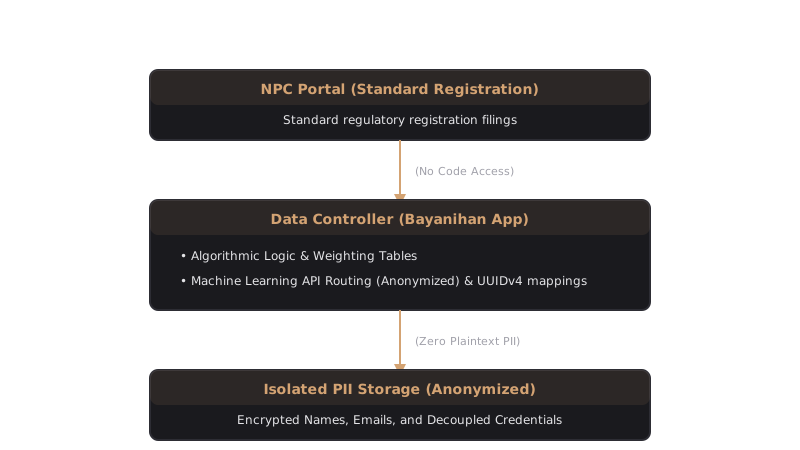
The system employs a strict Data Controller decoupling policy1. Personally Identifiable Information (PII), such as full names, email addresses, and physical locations, is stored in a physically and logically isolated database schema1. This PII database is structurally decoupled from the core application database, which processes transactions, submissions, and algorithmic rankings using cryptographically secure, random identifiers (UUIDv4)1. The platform’s analytical, scoring, and machine learning components only interact with these anonymous UUIDs1.
Standard registration with the NPC and the submission of the mandatory Privacy Impact Assessment (PIA) are performed via standard corporate compliance channels as a private commercial entity1. This setup eliminates any legal basis for state regulators to demand access to the platform’s proprietary algorithms, prompt libraries, or codebases during a privacy audit1.
Intellectual Property Architecture under RA 8293
The automated Terms of Service (ToS) enforce a tripartite split-rights framework under the Intellectual Property Code of the Philippines (Republic Act No. 8293) to protect independent researchers while ensuring operational utility to Problem Posters1:
- Copyright Ownership Retention (Section 172, RA 8293): The independent Researcher retains the moral and global copyright of the submitted solution document1. This ownership remains with the creator and cannot be claimed by the platform or the Problem Poster1.
- Irrevocable, Non-Exclusive License to Implement: Upon passing the validation pipeline and entering the active selection pool, the Researcher grants the Problem Poster a perpetual, royalty-free, worldwide, non-exclusive license to physically construct, deploy, or implement the proposed solution1.
- Platform Host and Citation Rights: The platform automatically secures an irrevocable right to host, abstract, index, and publish the solution text within its public, open-knowledge repository1. This license is granted for academic and citation purposes to build verifiable portfolio records1.
Financial and Escrow Autonomy and BSP Compliance
Under the National Payment Systems Act (NPSA, Republic Act No. 11127), any platform that receives, holds, or routes user funds directly is classified as an Operator of a Payment System (OPS)27. Under BSP Circular No. 1049, such entities must register with the BSP, exposing them to ongoing reporting requirements and financial audits27. Furthermore, engaging in merchant payment acceptance triggers the requirement of a Merchant Acquisition License (MAL) under MORPS Section 503 and BSP Memorandum No. M-2025-00230.
To bypass these regulatory licensing barriers, Bayanihan operates strictly as a non-financial information matchmaker1. It implements a point-to-point API integration with third-party, fully licensed payment gateways and escrow providers, such as Maya Business, PayMongo, or Xendit1.
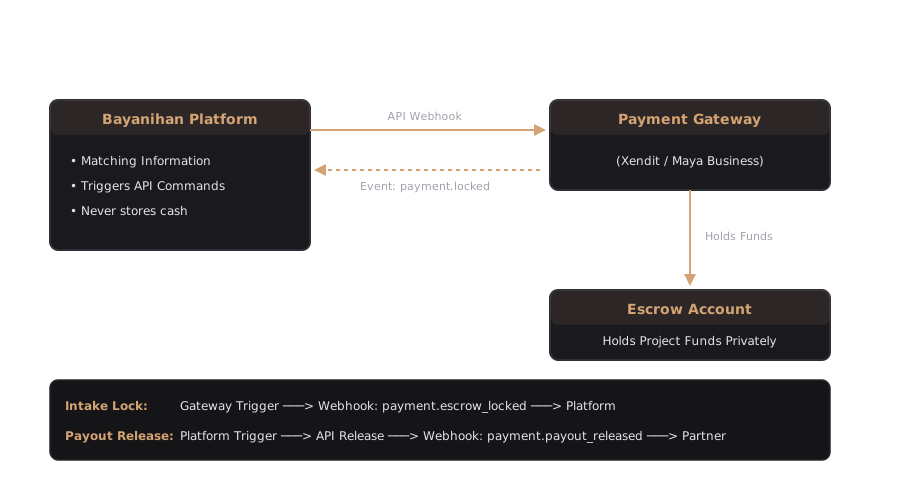
Because the platform never takes possession of, routes, or holds the transaction funds, it avoids direct BSP licensing requirements while remaining legally compliant1.
Private Organizational Structure and Foundational Hiring Matrix
Key Roles, Target Qualifications, and Performance Metrics
The core team required to execute Phase 0 and Phase 1 is structured as a private, high-performance unit1. The personnel must possess deep technical qualifications tailored to the local environment and the unique compliance demands of the platform1.
The hiring matrix is structured as follows:
| Role | Target Qualifications | Core Responsibilities | Key Performance Indicators (KPIs) |
|---|---|---|---|
| Principal Researcher / Founder | • Ph.D. or Master’s in Systems Engineering, Development Economics, or Cognitive Science. • 5+ years of experience in regional research methodologies1. | • Establish the regional baseline. • Supervise the seeding of initial case studies. • Oversee the quality standards of the validation engine1. | • Accuracy of the initial 20 seed case studies. • Operational stability of the academic partnership programs1. |
| Lead Technical Architect | • 6+ years in secure distributed systems architecture. • Deep expertise in PostgreSQL relational database design, Python/Node.js, and lightweight API construction1. | • Design the database schema. • Optimize LLM API routing. • Secure the platform’s anti-gaming and anti-collusion engines1. | • System response latency over unstable regional mobile networks. • API token cost efficiency per submission check1. |
| Mobile-First Full-Stack Engineer | • 4+ years of experience in building mobile-responsive applications. • Proficient in React Native, Flutter, or PWA technologies22. | • Develop the mobile-responsive interface. • Implement API hooks for payment gateways. • Construct the blind reviewer portal1. | • Time-to-interactive (TTI) on low-bandwidth connections in rural areas22. • Code test coverage percentage1. |
| Retained Tech Lawyer | • Member of the Integrated Bar of the Philippines (IBP) with a specialization in tech startups, RA 8293, and RA 101731. | • Maintain legal barriers against state interference. • Draft the platform’s ToS. • Manage NPC compliance filings1. | • Successful defense of the platform’s IP structure. • Zero regulatory audits escalating to direct database access1. |
Contractual Subject Matter Expert (SME) Reviewer Panel
The validation engine relies on a contractual panel of SME Reviewers to evaluate submissions that pass the automated AI quality gates1. These reviewers are sourced directly from private professional organizations, independent industry bodies, and private university faculties in Bulacan, such as the civil engineering program at Richwell Colleges35 or the information technology and business administration departments at CEU Malolos and LCUP13.
To prevent administrative bottlenecks and maintain financial sustainability, the platform implements a sustainable, self-funding economic model for reviewers22:
- Bootstrapping Phase (Phase 1): In the initial phase, when no financial transactions occur on the platform, reviewers are compensated using a dedicated private development fund22. This fund is established from private angel investments and initial non-profit research grants1. Reviewers are paid a flat fee of ₱350 to ₱500 per completed technical evaluation, with an expected SLA of 3 business days22.
- Operational Scale Phase (Phase 2 and Beyond): When Paid Cases go live, the reviewer economic model transitions to a self-sustaining transaction fee. The platform implements a flat 10% commission fee on all successfully completed Paid Cases. Of this amount, 70% is funneled directly into the category-specific Reviewer Pool to compensate the assigned blind auditor, while the remaining 30% is allocated to platform server maintenance and API routing overhead22.
System Architecture, Quality Engine, and Relational Database Schema
Sequential AI Validation and Blind Review Pipeline
The platform uses a sequential validation pipeline to process submissions. This pipeline uses low-cost AI agents to handle bulk screening before routing submissions to human reviewers1.
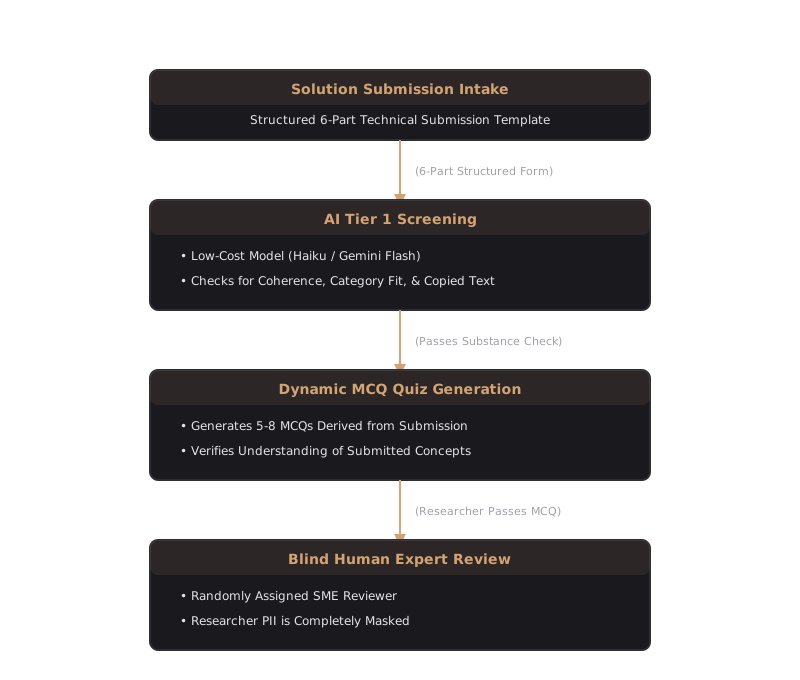
The pipeline operates through four distinct stages:
- Solution Submission Intake: Submissions must use a strict 6-part structured template: Problem Understanding, Root Cause Analysis, Proposed Technical/Operational Fix, Detailed Cost Estimation, Risks & Limitations, and Verified References1. Incomplete submissions are blocked at the client level1.
- AI Tier 1 Screening: A low-cost model, such as Anthropic Claude Haiku or Google Gemini Flash, performs initial screening1. It evaluates the text for basic coherence, category fit, plagiarism, and copied AI output1. If the submission is flagged for low quality, it is sent back to the researcher for revision22. It is never auto-rejected by AI alone without a human appeal path1.
- Dynamic MCQ Quiz Generation: To ensure the researcher understands their own submission and prevent copy-pasting, the AI model scans the text and generates 5 to 8 multiple-choice questions (MCQs)22. Each MCQ must feature one clear correct answer derived explicitly from the text22. The researcher must pass this quiz to unlock progression EXP and advance their submission1. If the submission is incoherent or contains gibberish, the generation script triggers a fallback flag, marking the submission as “Incoherent / Low Quality” and sending it back to the researcher22.
- Blind Human Expert Review: Once the quiz is passed, the submission is routed to a randomly assigned reviewer from the appropriate category pool1. The reviewer’s interface completely masks the researcher’s name, email, previous submissions, and current platform rank1. This ensures a blind, merit-based grading system1.
PostgreSQL Relational Database Schema
The implementation of Bayanihan’s isolated schemas, role levels, progress gates, and anti-collusion monitoring is built on the following PostgreSQL database schema1. The model uses cryptographicUUID values for all system identifiers, decoupling data from any external references1:
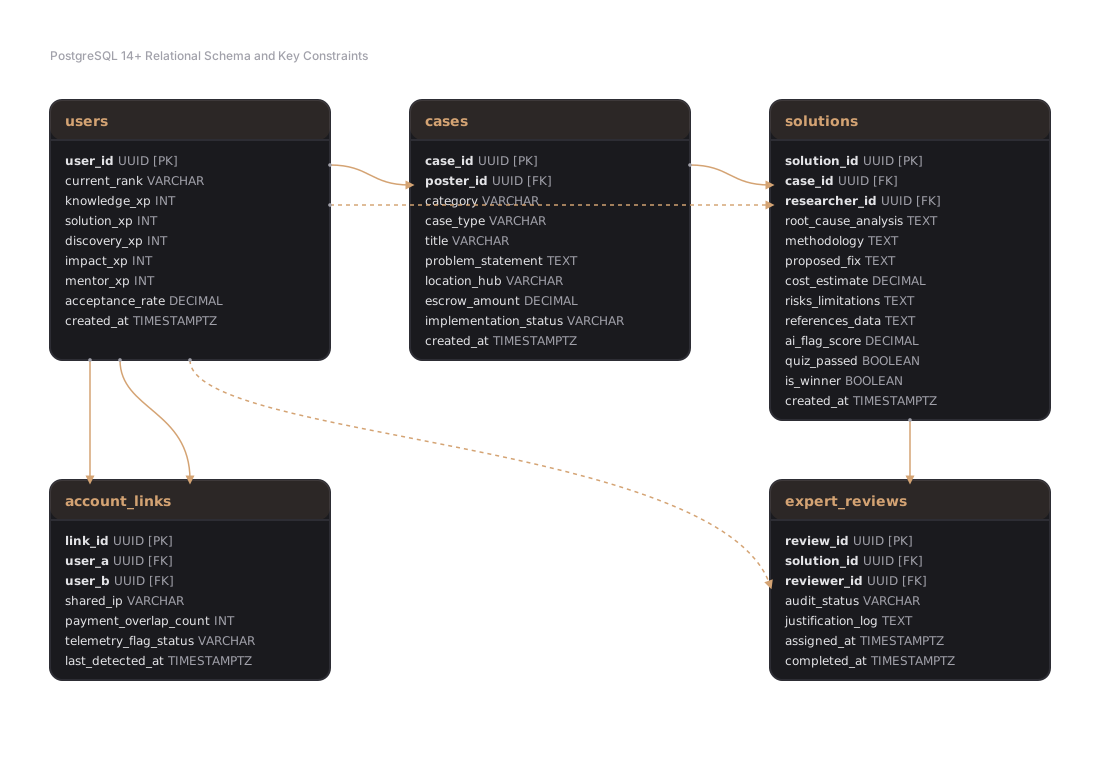
SQL
— Target Platform: PostgreSQL 14+
— Module: Core Scaffolding & Telemetry Database
CREATE EXTENSION IF NOT EXISTS “pgcrypto”;
— User Progress and Reputation Ledger (Strictly Anonymized UI Mapping)
CREATE TABLE users (
user_id UUID PRIMARY KEY DEFAULT gen_random_uuid(),
current_rank VARCHAR(50) DEFAULT ‘Novice’ NOT NULL,
knowledge_xp INT DEFAULT 0 NOT NULL,
solution_xp INT DEFAULT 0 NOT NULL,
discovery_xp INT DEFAULT 0 NOT NULL,
impact_xp INT DEFAULT 0 NOT NULL,
mentor_xp INT DEFAULT 0 NOT NULL,
acceptance_rate DECIMAL(5,2) DEFAULT 100.00 NOT NULL,
created_at TIMESTAMP WITH TIME ZONE DEFAULT CURRENT_TIMESTAMP NOT NULL,
CONSTRAINT chk_reputation_rank CHECK (current_rank IN (
‘Novice’, — Baguhan (0-199 XP)
‘Apprentice’, — Mag-aaral (200-599 XP)
‘Contributor’, — Kalahok (600-1499 XP)
‘Analyst’, — Mangsuri (1500-3999 XP)
‘Researcher’, — Mananaliksik (4000-9999 XP)
‘Senior Researcher’, — Dalubhasa (10000-24999 XP)
‘Expert’, — Eksperto (25000-59999 XP)
‘Bayanihan Master’ — Bayani ng Bayan (60000+ XP)
)),
CONSTRAINT chk_acceptance_bounds CHECK (acceptance_rate >= 0.00 AND acceptance_rate <= 100.00)
);
— Decentralized Problem Register (Cases Marketplace)
CREATE TABLE cases (
case_id UUID PRIMARY KEY DEFAULT gen_random_uuid(),
poster_id UUID REFERENCES users(user_id) ON DELETE SET NULL,
category VARCHAR(50) NOT NULL,
case_type VARCHAR(50) NOT NULL,
title VARCHAR(255) NOT NULL,
problem_statement TEXT NOT NULL,
location_hub VARCHAR(255) NOT NULL, — e.g., ‘Malolos, Bulacan’ or ‘Plaridel, Bulacan’
escrow_amount DECIMAL(12,2) DEFAULT 0.00 NOT NULL,
implementation_status VARCHAR(50) DEFAULT ‘Researching’ NOT NULL,
created_at TIMESTAMP WITH TIME ZONE DEFAULT CURRENT_TIMESTAMP NOT NULL,
CONSTRAINT chk_category_type CHECK (category IN (
‘Environment’, ‘Agriculture’, ‘Technology’, ‘Education’, ‘Business’,
‘Health’, ‘Transportation’, ‘Disaster Preparedness’, ‘Energy’, ‘Social Problems’, ‘Academic’
)),
CONSTRAINT chk_case_pricing CHECK (case_type IN (‘Practice’, ‘Community’, ‘Paid’)),
CONSTRAINT chk_lifecycle_state CHECK (implementation_status IN (‘Researching’, ‘Funding Needed’, ‘In Progress’, ‘Implemented’))
);
— Structured Submissions (6-Part Analytical Submissions)
CREATE TABLE solutions (
solution_id UUID PRIMARY KEY DEFAULT gen_random_uuid(),
case_id UUID REFERENCES cases(case_id) ON DELETE CASCADE NOT NULL,
researcher_id UUID REFERENCES users(user_id) ON DELETE SET NULL,
root_cause_analysis TEXT NOT NULL,
methodology TEXT NOT NULL,
proposed_fix TEXT NOT NULL,
cost_estimate DECIMAL(12,2) NOT NULL,
risks_limitations TEXT NOT NULL,
references_data TEXT NOT NULL,
ai_flag_score DECIMAL(3,2) DEFAULT 0.00 NOT NULL,
quiz_passed BOOLEAN DEFAULT FALSE NOT NULL,
is_winner BOOLEAN DEFAULT FALSE NOT NULL,
created_at TIMESTAMP WITH TIME ZONE DEFAULT CURRENT_TIMESTAMP NOT NULL,
CONSTRAINT chk_flag_range CHECK (ai_flag_score >= 0.00 AND ai_flag_score <= 1.00)
);
— Blind Expert Human Review Track
CREATE TABLE expert_reviews (
review_id UUID PRIMARY KEY DEFAULT gen_random_uuid(),
solution_id UUID REFERENCES solutions(solution_id) ON DELETE CASCADE NOT NULL,
reviewer_id UUID REFERENCES users(user_id) ON DELETE SET NULL,
audit_status VARCHAR(50) DEFAULT ‘Pending’ NOT NULL,
justification_log TEXT,
assigned_at TIMESTAMP WITH TIME ZONE DEFAULT CURRENT_TIMESTAMP NOT NULL,
completed_at TIMESTAMP WITH TIME ZONE,
CONSTRAINT chk_validation_status CHECK (audit_status IN (‘Pending’, ‘Approved’, ‘Rejected’))
);
— Anti-Collusion Telemetry and Multi-Account Linking Register
CREATE TABLE account_links (
link_id UUID PRIMARY KEY DEFAULT gen_random_uuid(),
user_a UUID REFERENCES users(user_id) ON DELETE CASCADE NOT NULL,
user_b UUID REFERENCES users(user_id) ON DELETE CASCADE NOT NULL,
shared_ip VARCHAR(45),
payment_overlap_count INT DEFAULT 0 NOT NULL,
telemetry_flag_status VARCHAR(50) DEFAULT ‘Clear’ NOT NULL,
last_detected_at TIMESTAMP WITH TIME ZONE DEFAULT CURRENT_TIMESTAMP NOT NULL,
CONSTRAINT unique_user_pair UNIQUE (user_a, user_b),
CONSTRAINT chk_links_order CHECK (user_a < user_b),
CONSTRAINT chk_telemetry_state CHECK (telemetry_flag_status IN (‘Clear’, ‘Flagged’, ‘Suspended’))
);
— Multi-Index Definitions for Performance and Low-Latency Query Pipelines
CREATE INDEX idx_cases_category_loc ON cases(category, location_hub);
CREATE INDEX idx_solutions_scoring ON solutions(case_id, quiz_passed, is_winner);
CREATE INDEX idx_reviews_routing ON expert_reviews(reviewer_id, audit_status);
CREATE INDEX idx_links_shared_telemetry ON account_links(shared_ip, telemetry_flag_status);
Private Seeding and Outreach Strategy
The Authentic Seeding Protocol
To solve the “empty marketplace” problem without using artificial master administrator accounts—which reduce platform credibility—Bayanihan uses a decentralized seeding protocol22. During the initial 30-day pre-launch window, the founding team carries out direct field operations along the Malolos and Plaridel corridors1. They interview local cooperative operators and micro-businesses, such as members of the Samahang Manggagawa Credit Cooperative and the Parulan Halang Irrigators Association, to document active technical and operational challenges4.
These real-world problems are typed and mapped directly to separate, individualized user accounts representing the respective domain owners1. This approach ensures that the initial 15 to 20 case studies are geocoded to authentic community sources from day one1.
Grassroots Sourcing and Socratic Sourcing Pipelines
To preserve operational security and avoid state scrutiny, the platform bars all public social media advertising and vanity marketing campaigns1. Instead, user acquisition relies on targeted, grassroots academic sourcing through closed-loop professional networks and private student organizations1:
- Socratic Outreach inside Private HEIs: Direct pitches are delivered to student computing organizations, engineering councils, and business clubs within LCUP13, CEU Malolos16, and Richwell Colleges21.
- The Portfolio Value Proposition: The platform is presented to students as a secure, verified portfolio generator1. Students are shown how solving real-world agricultural, logistical, and technical cases creates a cryptographically auditable, peer-reviewed professional record that can serve as a highly credible replacement for a traditional resume1.
Corporate Sponsor Sourcing and Information Firewalls
To secure corporate philanthropic funds under NIRC Section 34(H) while protecting the integrity of the crowdsourcing model, the platform enforces strict structural firewalls1:
- The Review Process Firewall: Corporate sponsors are restricted to a read-only interface1. They cannot view pending submissions, communicate with the blind reviewer pool, or contact the Problem Poster during the active research and evaluation phases1.
- Post-Verification Engagement Only: Sponsors can interact with submissions and allocate implementation funds only after independent SME reviewers have fully approved the solutions for technical and operational feasibility1. This structure prevents corporate capture, favoritism, and bias, ensuring that capital is routed only to technically viable community solutions1.
Technical and Operational Scaffolding Plans
Build Phase Sequence
The deployment of Bayanihan is divided into six sequential, test-driven phases1. Each phase must achieve operational stability before the next is initiated1.
The build phase sequence is structured as follows:
| Phase | Title | Structural Objectives | Bulacan Integration Focus |
|---|---|---|---|
| Phase 0 | Pre-Build Scaffolding1 | Draft legal ToS, initiate standard NPC filings, design prompts, and execute the 30-day seeding protocol1. | Map and seed 20 active cases from the Malolos-Plaridel corridor to separate domain-owner accounts1. |
| Phase 1 | Non-Monetized Loop1 | Deploy core system mechanics: structured submissions, AI screening, dynamic quizzes, and manual reviews1. | Launch with a focus on three areas: Agriculture, Technology, and Environment, using student cohorts from private HEIs1. |
| Phase 2 | Escrow Integration1 | Integrate point-to-point payment APIs, establish the third-party escrow contract, and implement secure payouts1. | Connect private microfinance and credit cooperators, enabling secure, peer-to-peer funded cases1. |
| Phase 3 | Sponsoring Dashboard1 | Launch the Corporate CSR Analytics Dashboard with an automated verification system for tax deduction documentation1. | Interface with commercial partners to secure funding for approved Community Cases1. |
| Phase 4 | Field Implementation1 | Implement the geocoded Implementation Badge, field researcher verification, and systematic project tracking logs1. | Deploy solutions to address regional infrastructure issues, such as seasonal flooding in Barangay Barihan4. |
| Phase 5 | Self-Sustaining Ecosystem1 | Open the expert-rank reviewer pool, establish mentor programs, and deploy mobile-responsive applications1. | Fully integrate CITE and CBEA program curricula, allowing direct academic credit tracking via the API1. |
Systematic Risk Register
To protect the platform’s long-term viability, potential operational and legal challenges are tracked through a systematic risk register:
| Risk Element | Severity | Mitigation Protocol | Regulatory / Legal Standard |
|---|---|---|---|
| Direct BSP Classification | Critical | Act strictly as an information matchmaker using point-to-point gateway integrations (Xendit/Maya)1. Never route or hold transaction funds directly1. | National Payment Systems Act (NPSA) / BSP Circular No. 104927. |
| Regulatory Data Audits | Critical | Implement complete separation of data roles1. Store PII separately and use anonymized UUIDs for transaction analysis to protect algorithmic code from direct audits1. | Data Privacy Act of 2012 (Republic Act No. 10173)1. |
| Reviewer Bottleneck | High | Establish a professional, paid SME panel with clear SLAs during Phase 122. Transition to a self-funding commission model in Phase 222. | Private Independent Contractor and Service Level Agreements1. |
| Corporate Capture | Medium | Enforce strict structural firewalls that restrict sponsor visibility to verified, post-review solutions1. Banish direct communication with reviewers1. | Corporate Governance Framework and Section 34(H) of the NIRC1. |
Execution Checklist and Timeline
The operational checklist for Phase 0 and Phase 1 is structured to ensure systematic execution before writing a single line of code1:
| Priority Level | Technical / Legal Task | Core Objective | Timeline |
|---|---|---|---|
| Immediate | Engage Retained Tech Counsel1. | Draft standard ToS under RA 8293 and initiate NPC compliance filings1. | Week 1 |
| Immediate | Execute Seeding Protocol1. | Interview local Bulacan cooperatives to geocode and map the first 20 cases1. | Weeks 1–4 |
| Pre-Launch | Build Prompt and Quiz Libraries1. | Write and test AI prompts for substance flags and MCQ generation1. | Weeks 3–6 |
| Pre-Launch | Recruit Category Reviewers1. | Secure 5 contractual SME reviewers from private professional registries in Bulacan1. | Weeks 5–8 |
| Phase 1 | Construct Reviewer Dashboard1. | Build the blind reviewer portal with complete PII masking1. | Weeks 9–12 |
| Phase 1 | Execute Socratic Academic Recruitment1. | Recruit the first 50 student researchers through private HEI channels1. | Weeks 11–14 |
Conclusions and Actionable Technical Recommendations
Technical Integration and Structural Recommendations
The technical, structural, and legal analysis of the Bulacan region’s socioeconomic landscape indicates that Bayanihan’s crowdsourcing model is viable if it maintains strict operational independence from government agencies1. To ensure long-term stability and quality control, the platform must systematically execute the following technical recommendations:
- Enforce Strict Database Separation: Build the user PII database as a physically and logically decoupled system1. Use secure API tokens to map anonymized transaction UUIDv4 profiles, shielding the platform’s core algorithmic code from external privacy audits1.
- Establish Direct Private HEI Partnerships: Integrate the “Premium Portfolio Builder” API with deans and program heads at LCUP13, CEU Malolos16, and Richwell Colleges21. This creates a direct pipeline for student recruitment while bypassing state administrative overhead1.
- Implement Point-to-Point Payment Gateways: Deploy automated payment webhooks using Maya or Xendit APIs to manage payouts1. Using third-party, merchant-managed escrow accounts ensures the platform never holds or routes transaction funds directly, avoiding classification as a BSP-regulated Operator of a Payment System1.
- Deploy Sequential AI and Blind Human Quality Gates: Enforce a strict sequential quality pipeline: low-cost AI triage, substance flags, and dynamically generated MCQs1. Submissions that pass these automated gates are routed to a blind human reviewer panel with complete PII masking to ensure a purely merit-based validation loop1.
- Build a Closed-Loop CSR Funding Model: Present the platform’s CSR Analytics Dashboard directly to corporate partners in Bulacan1. This allows corporations to claim itemized tax deductions under the CREATE Law for funding verified community solutions, while maintaining a strict information firewall to prevent corporate capture1.
Works cited
- plan.html
- Provincial Cooperative and Enterprise Development Office - Provincial Government of Bulacan, https://bulacan.gov.ph/government/offices/pcedo/
- POVERTY ALLEVIATION IN RURAL AREAS: ASSET REFORM VIA GRASSROOTS AND COOPERATIVE INITIATIVES - Office of the Ombudsman, https://www.ombudsman.gov.ph/UNDP4/wp-content/uploads/2013/01/Case1_DevGdGov.pdf
- AFC, PCAF PMT tracks Bulacan DA-funded programs and projects, https://pcaf.da.gov.ph/index.php/2021/10/15/afc-pcaf-pmt-tracks-bulacan-da-funded-programs-and-projects/
- Agriculture - Municipality of Plaridel Bulacan, https://plaridelbulacanlgu.ph/offices/agriculture/
- Driving directions to Bulacan Provincial Agriculture Office, Malolos - Waze, https://www.waze.com/live-map/directions/bulacan-provincial-agriculture-office-malolos?to=place.w.79167637.791807437.19168092
- Bulacan State University - Wikipedia, https://en.wikipedia.org/wiki/Bulacan_State_University
- A Qualitative Inquiry into Challenges Faced by Computer Engineering Students in Bulacan State University in Co - RSIS International, https://rsisinternational.org/journals/ijrsi/uploads/vol13-iss3-pg1901-1906-202604_pdf.pdf
- Package Printing Sustainable Practices in BulSU Hostel and Dormitory: An Assessment and Enhancement in Alignment with the United, https://packageprinting.org/pp/article/view/187/11
- Page 1 | 18 COOPERATIVES ALL OVER THE COUNTRY GOING THE EXTRA MILE TO SERVE THEIR MEMBERS AND COMMUNITIES AMIDST COVID-19 PANDEM - CDA, https://cda.gov.ph/wp-content/uploads/2020/12/2020-05-28-coop-covid-part11-r03.pdf
- Page 1 | 19 COOPERATIVES ALL OVER THE COUNTRY GOING THE EXTRA MILE TO SERVE THEIR MEMBERS AND COMMUNITIES AMIDST COVID-19 PANDEM - CDA, https://cda.gov.ph/wp-content/uploads/2020/12/2020-05-20-coop-covid-part10-r03.pdf
- BulSU-LCP - Reseach Management - Google Sites, https://sites.google.com/bulsu.edu.ph/learningcontinuityplan/home/reseach-management
- La Consolacion University Philippines: Rankings, Course Details and Scholarships | Educatly, https://www.educatly.com/university/68069/la-consolacion-university-philippines
- La Consolacion University Philippines - Wikipedia, https://en.wikipedia.org/wiki/La_Consolacion_University_Philippines
- Programs Offered - La Consolacion University Philippines, https://www.lcup.edu.ph/admission_program_offered.php
- Contact Us - CEU, https://www.ceu.edu.ph/contacts/4
- Centro Escolar University Malolos | aguirreleslie - WordPress.com, https://aguirreleslie.wordpress.com/2013/03/19/centro-escolar-university-malolos/
- TVI with Registered Program - Tesda, https://www.tesda.gov.ph/Tvi/Result?page=15&locFilter=bulacan
- RICHWELL COLLEGES GETS ACCREDITATION AS ASSESSMENT CENTER, https://bulacan.tesda3.com/richwell-colleges-gets-accreditation-as-assessment-center/
- Centro Escolar University, https://upm.vn/university/25
- Leap of Faith - Richwell Colleges, https://nickodeguzman.github.io/rw.web/history.html
- blueprint-review.md
- TESDA Bulacan distributed allowances for 169 UAQTEA scholars at Richwell Colleges, Inc. at Plaridel Bulacan, https://www.tesda3.com.ph/tesda-bulacan-distributed-allowances-for-169-uaqtea-scholars-at-richwell-colleges-inc-at-plaridel-bulacan/
- Rules for Claiming Charitable Contributions as Tax Deductions in the Philippines, https://www.respicio.ph/commentaries/rules-for-claiming-charitable-contributions-as-tax-deductions-in-the-philippines
- Tax Rules on Donations by Corporations to Accredited Donee Institutions in the Philippines, https://www.respicio.ph/commentaries/tax-rules-on-donations-by-corporations-to-accredited-donee-institutions-in-the-philippines
- Claiming Tax Benefits - Ombudsman, https://www.ombudsman.gov.ph/UNDP4/wp-content/uploads/2012/12/S-T-E-P-7.pdf
- FAQs on Registration of Operators of Payment Systems - BSP, https://www.bsp.gov.ph/PaymentAndSettlement/FAQ_OPS_Registration.pdf
- Roles of BSP Real Time Gross Settlement (PhilPaSS plus ) National Retail Payment System - Bangko Sentral ng Pilipinas, https://www.bsp.gov.ph/SitePages/PaymentsAndSettlements/PaymentsAndSettlements.aspx/%7B%7BGetWebAbsoluteURL()+%20’/Media_and_Research/Primers%20Faqs/%7B%7BGetWebAbsoluteURL()+%20’/PaymentAndSettlement/Application%20for%20Registration%20as%20OPS%20and%20or%20MAL.xlsx’%7D%7D
- Benoxo Senrnrl N@ PlurprNrg - BSP, https://www.bsp.gov.ph/Regulations/Issuances/2019/m023.pdf
- Frequently Asked Questions (FAQs) regarding Circular No. 1198 on the Regulatory Framework for Merchant Payment Accept - BSP, https://www.bsp.gov.ph/Regulations/Issuances/2024/1198%20-%20FAQ.pdf
- Merchant Acquisition License Guidelines | PDF | Payments | Business - Scribd, https://www.scribd.com/document/832820673/BSP-Memorandum-No-M-2025-002
- Xendit Status, https://status.xendit.co/
- 7 Top E-Commerce or Digital Payment Gateways in the Philippines - WAZILE Inc., https://www.wazile.com/blog/top-e-commerce-or-digital-payment-gateways-in-the-philippines/
- Payouts via API - Xendit Docs, https://docs.xendit.co/docs/payouts-via-api
- Evaluation Instrument for Richwell Colleges | PDF | Master Of, https://www.scribd.com/document/886347394/Form-2a-Updated-docx