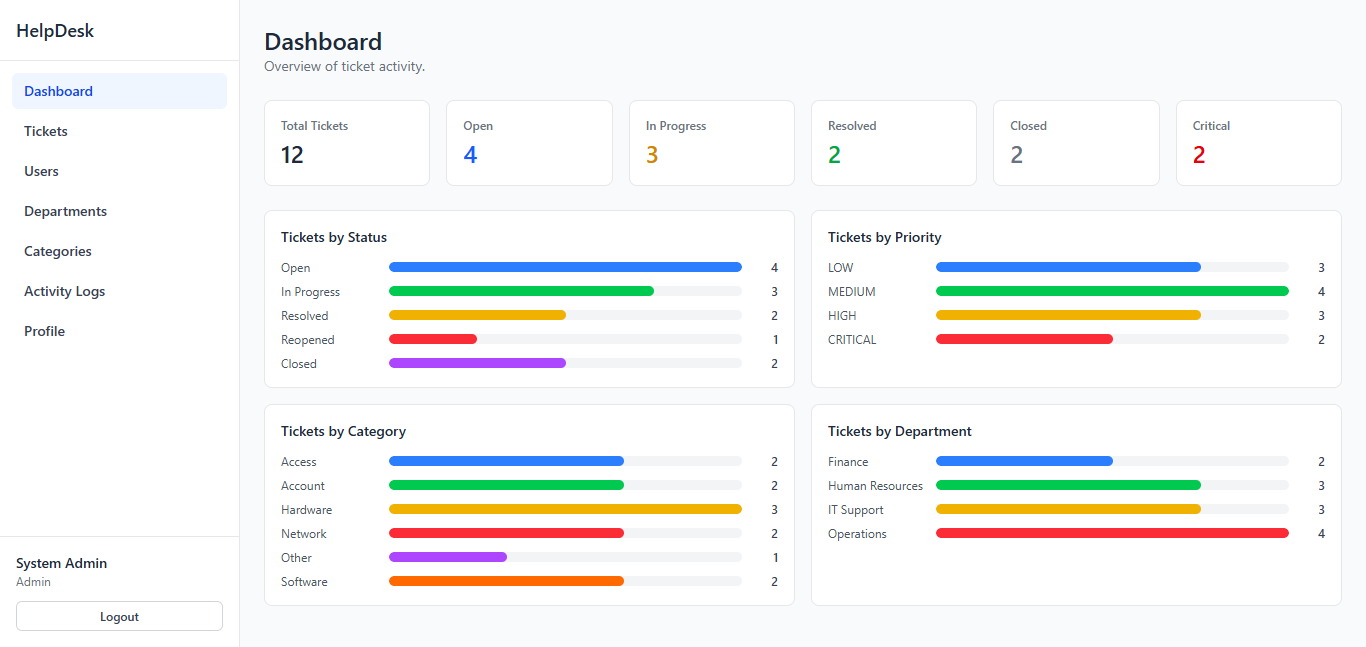
1. Dashboard
Live ticket totals, open/in-progress/resolved counts, and critical-ticket highlights at a glance.
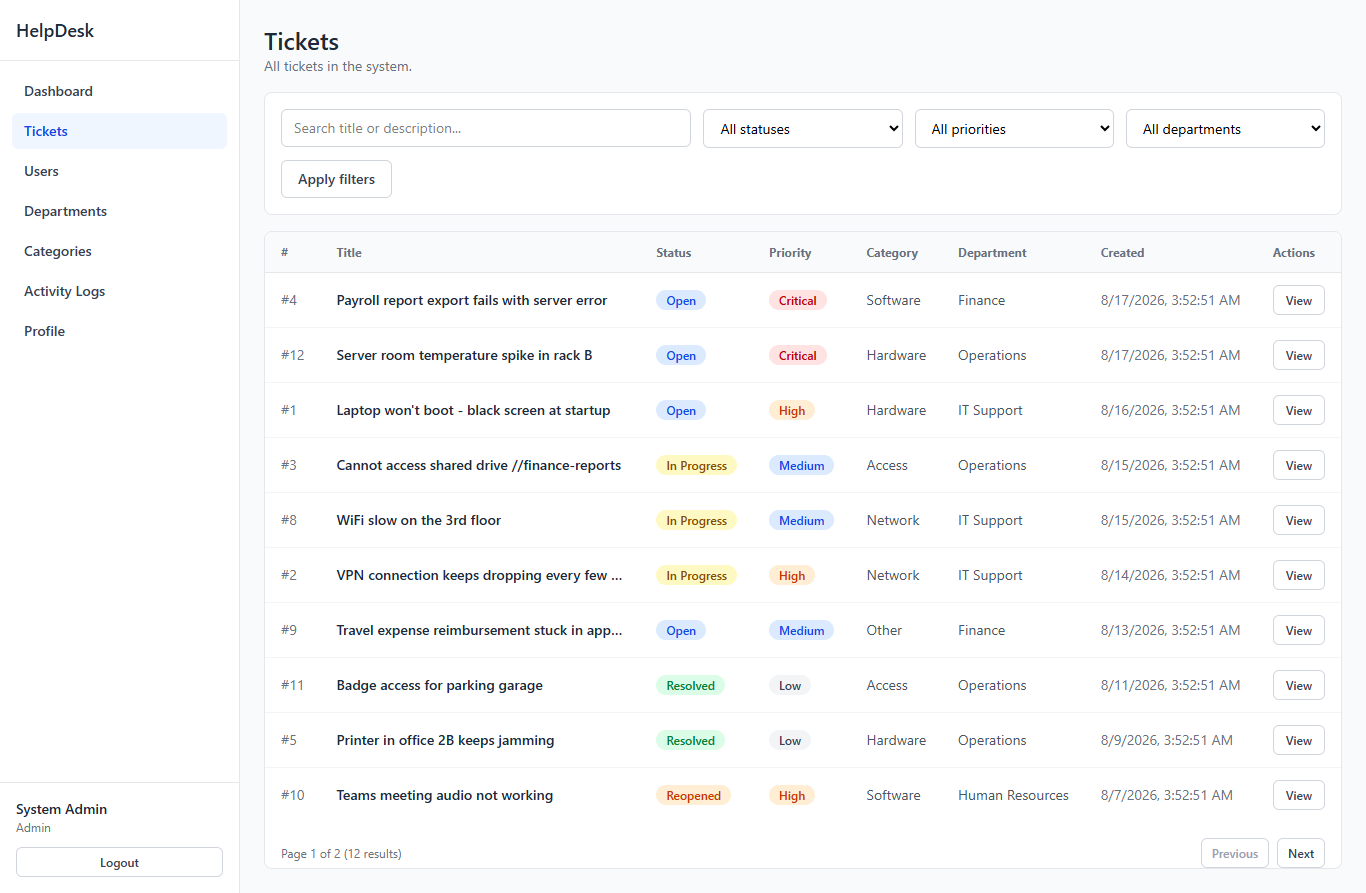
2. Ticket Queue
Filterable ticket table with priority, status, assignment, and search across the full ticket backlog.
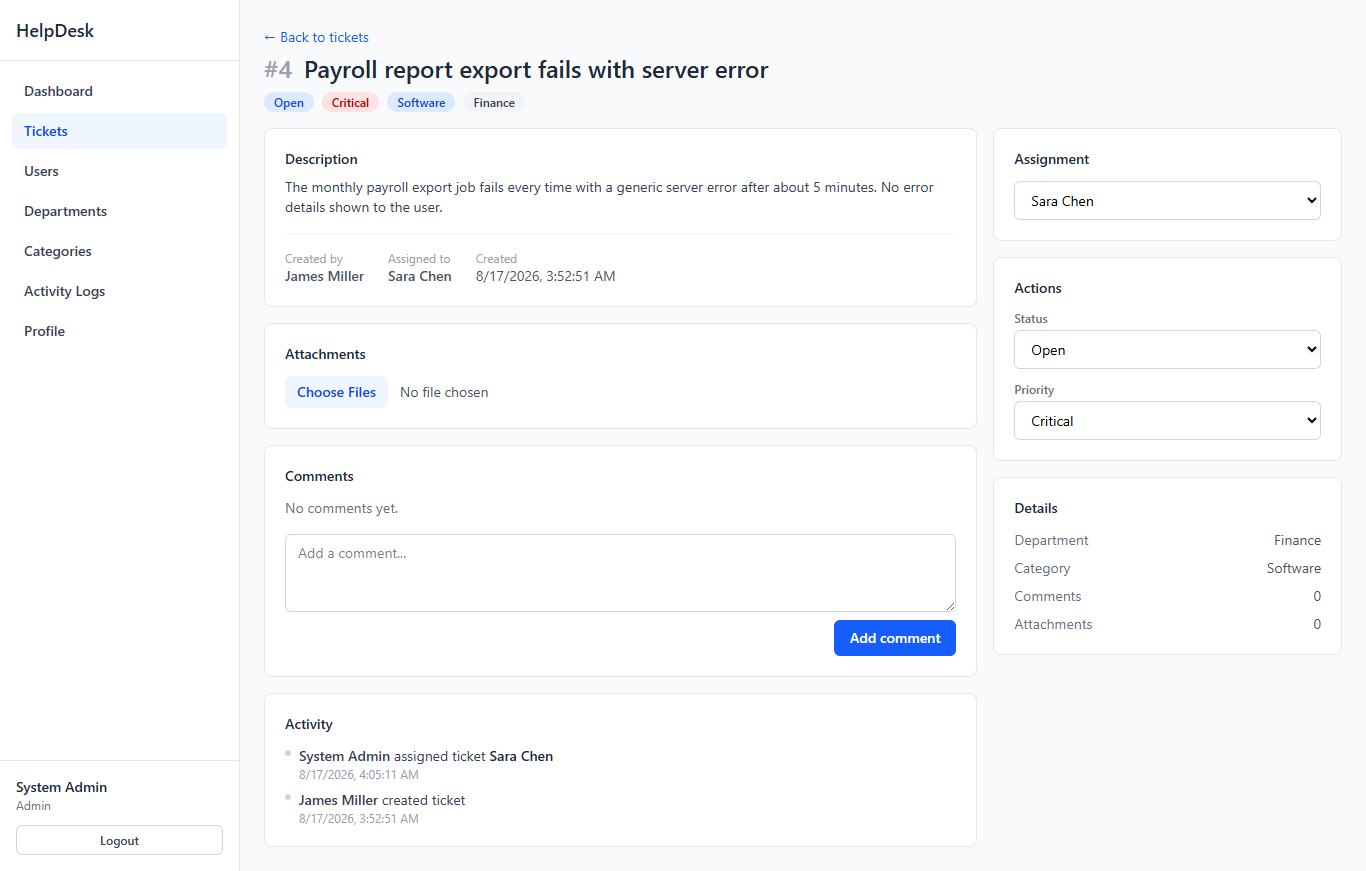
3. Ticket Detail
Description, comment thread, attachments, and a full activity timeline for a single ticket.
HelpDesk Ticketing System
A Full-Stack ASP.NET Core + React Service Desk with Role-Based Access, JWT Authentication, and a Complete Ticket Lifecycle
At a Glance
- Problem
- Support requests scattered across email and chat, with no ownership, status, or audit trail.
- Role
- Designed and built the full-stack system: ASP.NET Core API, React frontend, schema, JWT auth, and role-based access.
- Solution
- A structured help desk with three roles, a defined ticket lifecycle, and a complete activity ledger.
- Result
- Every ticket is owned, assigned, and audited end-to-end, with role-aware dashboards for backlog and turnaround.
- Proof
- Live demo, GitHub repository, screenshots, and the schema and API documentation below.
Executive Summary
HelpDesk is a production-ready help desk ticketing system built on ASP.NET Core (.NET 10) with a React + TypeScript frontend. It replaces scattered email threads and spreadsheets with a structured service desk: employees raise tickets, technicians resolve them, and admins manage users, departments, and categories.
Access is enforced by JWT authentication and three roles (Employee, Technician, Admin). Every ticket moves through a defined lifecycle while a ticket_activity_logs ledger records who did what, making the entire support workflow traceable.
The Support Chaos
- • Lost Requests: Issues submitted over email and chat disappear into inboxes with no single source of truth.
- • No Ownership: Nobody knows who is working on what, and duplicate or unassigned tickets fall through the cracks.
- • No Audit Trail: Status changes, reassignments, and resolutions happen silently with no record of who did what.
- • No Visibility: Managers lack metrics on backlog, turnaround, and workload per department.
The Structured Service Desk
- • Centralized Tickets: Every request becomes a ticket with title, category, department, priority, and status.
- • Clear Ownership: Admins assign technicians; technicians see their queue and resolve tickets with full accountability.
- • Full Activity Log: Creation, assignment, status/priority changes, and comments are all recorded on a timeline.
- • Role-Based Dashboards: Live metrics for open, in-progress, resolved, and critical tickets per department and category.
Core Architecture
1. ASP.NET Core API + EF Core
A versioned /api/v1 JSON API powers the React frontend. Entity Framework Core maps seven normalized tables, and ASP.NET Core Identity handles password hashing while JWT bearer tokens secure every protected route.
- Role-based
[Authorize]guards enforce Employee, Technician, and Admin boundaries. - Tickets are treated as stateful resources; assignment, status, and priority changes flow through dedicated
PATCHendpoints. - Attachments use
multipart/form-datawith size, MIME, and metadata validation stored in the DB.
2. React + TypeScript Frontend
Built with Vite and Tailwind CSS, the client uses TanStack Query for server-state caching and React Hook Form + Zod for validated forms:
- Role-aware sidebar and protected routes via React Router.
- Ticket queue with search, filters (status, priority, category, department), and pagination.
- Ticket detail view combining description, comment thread, attachments, and an activity timeline.
- Automatic Axios
Authorization: Bearerinjection from the auth store.
3. Ticket Lifecycle & Activity Audit
Tickets progress through OPEN → IN_PROGRESS → RESOLVED → CLOSED, with REOPENED as a recovery path. Priorities range from LOW to CRITICAL. Every meaningful event writes a ticket_activity_logs entry with old/new values, giving a complete, chronological audit of each ticket.
Database & Schema Design
Seven normalized tables (SQLite by default, PostgreSQL-ready) model the full service desk domain while keeping historical activity and file metadata separate from live state:
users
Identity + Roles- email [UNIQUE] string(255)
- department_id [FK] nullable
- role employee | technician | admin
- password_hash string
- is_active boolean
departments
1 : * users- name string(255)
- description text nullable
IT Support, HR, Finance, Operations.
categories
1 : * tickets- name string(255)
- description text nullable
Hardware, Software, Network, Account, Access, Other.
tickets
Core Resource- created_by_id [FK] unsigned bigint
- assigned_to_id [FK NULL] nullable
- category / department [FK] unsigned bigint
- priority low | medium | high | critical
- status open | in_progress | resolved | reopened | closed
ticket_comments
Communication- ticket_id [FK CASCADE] unsigned bigint
- user_id [FK] unsigned bigint
- content text
ticket_attachments
File Metadata- ticket_id [FK CASCADE] unsigned bigint
- file_name / file_path string
- file_size bigint
- mime_type string
ticket_activity_logs
Audit Ledger- ticket_id [FK CASCADE] unsigned bigint
- user_id [FK] unsigned bigint
- action string
- old_value / new_value string nullable
REST API Surface
A clean, versioned JSON API under /api/v1 powers the React frontend and any future integrations:
| Domain | Key Endpoints | Description |
|---|---|---|
| Auth | POST /api/v1/auth/login · register · logout | JWT issue and session management via ASP.NET Core Identity. |
| Tickets | GET/POST/PUT/DELETE /api/v1/tickets | Search, filter, sort, and paginate; PATCH for assignment, status, and priority. |
| Comments | GET/POST /api/v1/tickets/{id}/comments | Nested thread with edit/delete authorization checks. |
| Attachments | POST /api/v1/tickets/{id}/attachments | Multipart upload with size and MIME validation; metadata stored in DB. |
| Activity | GET /api/v1/tickets/{id}/activity | Read-only timeline of every change, with optional admin-wide filters. |
| Dashboard | GET /api/v1/dashboard/summary · tickets-by-* | Role-aware metrics: totals, status, priority, category, and department. |
Key Benefits & Tangible Outcomes
End-to-End Accountability
Every ticket is owned, assigned, and audited from creation to closure, eliminating lost or duplicate requests.
Complete Audit Trail
Status, priority, and assignment changes are logged with old/new values for full traceability.
Strict Role Isolation
Employees see their own tickets, technicians see their queue, and admins manage the entire system.
Data-Driven Support
Role-aware dashboards surface backlog, resolution, and critical tickets by department and category.
Need a help desk or internal ticketing tool?
Let's coordinate to build secure .NET backends, role-based React dashboards, or workflow automation tailored to your team.
Get in Touch →